Blog

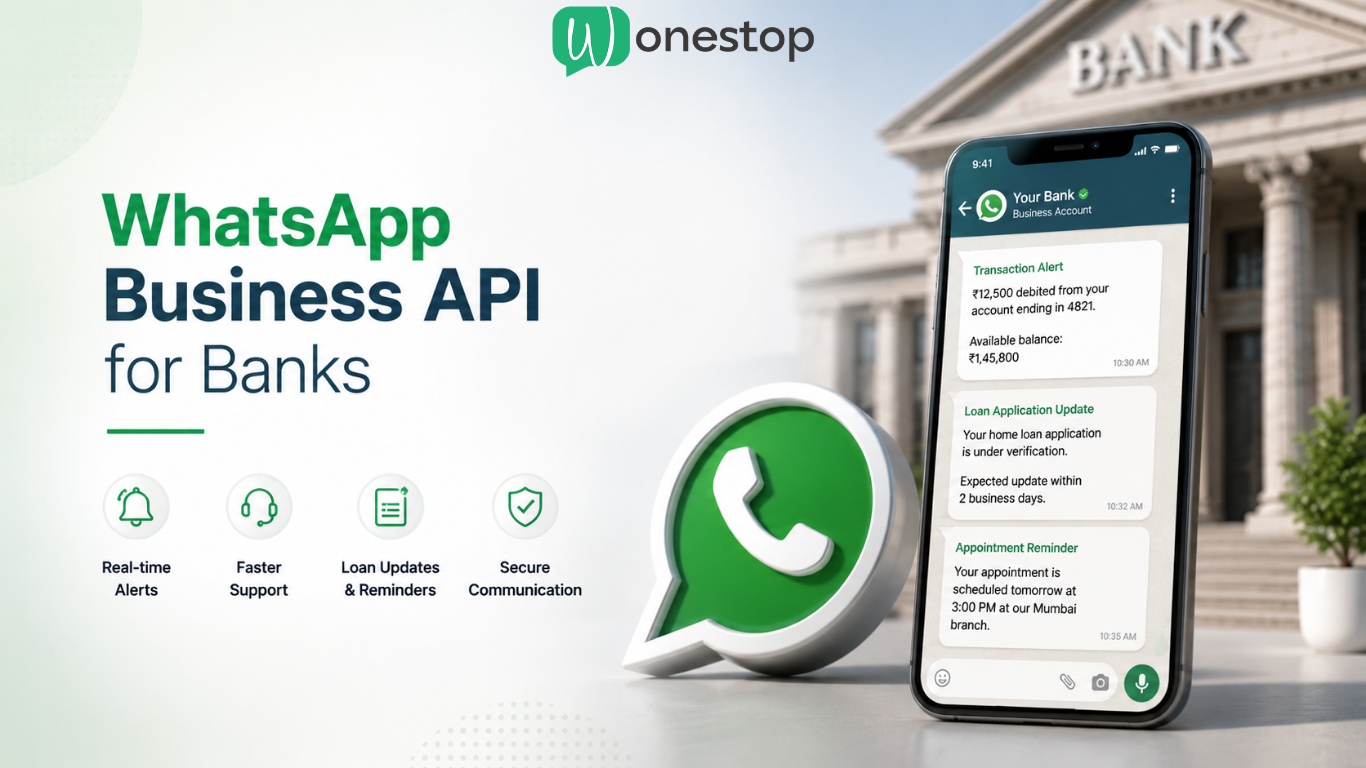
  • WhatsApp Business API for Bank: Improve Customer Communication, Support and  Customer Experience

    WhatsApp Business API for Bank: Improve Customer Communication, Support and Customer Experience

    Customers today expect faster, simpler, and more convenient communication from their banks.

    They no longer want to wait on calls, visit branches for simple updates, or search through emails for important information. Whether it’s checking a loan application status, receiving a transaction alert, or resolving an account issue, customers expect quick and reliable communication.

    Traditional channels such as phone calls, SMS, and email still matter. However, customer behavior has changed. People now prefer communication that is instant, accessible, and available on platforms they already use every day.

    This is where WhatsApp is becoming an important communication channel for banks.

    From transaction alerts and customer support to loan updates and appointment reminders, WhatsApp helps financial institutions communicate faster while improving the overall customer experience.

    How Banks Can Use WhatsApp at a Glance

    Banks can use WhatsApp to:

    • Send transaction and account alerts instantly
    • Share loan and credit card application updates
    • Provide faster customer support without long wait times
    • Send OTP and verification messages
    • Reduce missed appointments and branch visits
    • Share personalized financial updates and reminders
    • Keep customers informed throughout important banking processes

    The goal is simple:

    Help customers get the information they need without unnecessary delays.

    Why Does Banking Customer Communication Need to Change?

    Banking has changed significantly in the last few years.

    Customers now expect the same level of speed and convenience from banks that they experience with other digital services.

    At the same time, banks are managing a growing number of customer enquiries related to:

    • Loan applications
    • Credit card requests
    • Account-related issues
    • KYC verification
    • Transaction concerns
    • Branch appointments

    One of the biggest challenges banks face today is not attracting customer enquiries — it is responding quickly enough.

    When customers do not receive updates on time, uncertainty increases. In many cases, customers begin exploring alternative providers simply because communication feels slow or unclear.

    Messaging platforms such as WhatsApp help reduce this communication gap by keeping customers informed throughout the process.

    Why Fast Communication Matters in Banking

    One of the most common reasons customers become frustrated during financial journeys is delayed communication.

    For example, a customer applying for a home loan may wait several days without any update. Even if the application is progressing internally, the absence of communication creates uncertainty.

    Similarly, delayed responses to credit card applications, transaction disputes, or service requests often lead to repeated support calls and customer dissatisfaction.

    Keeping customers informed at every stage creates a smoother experience and reduces unnecessary support pressure.

    What is the WhatsApp Business API for Banks?

    The WhatsApp Business API is an enterprise-grade communication solution that allows banks and financial institutions to interact with customers securely and at scale.

    Unlike a standard WhatsApp Business account, it enables banks to:

    • Send automated notifications
    • Share account and transaction updates
    • Automate customer support interactions
    • Send OTP and verification messages
    • Share loan application progress
    • Improve customer engagement through structured communication

    More importantly, it allows banks to communicate quickly while maintaining professional and secure customer interactions.

    How Can Banks Use WhatsApp for Customer Support?

    Customer support is one of the strongest use cases for WhatsApp in banking.

    Many banking queries are repetitive and time-sensitive.

    Customers frequently ask:

    • What is my loan application status?
    • Has my KYC been approved?
    • What documents are needed for a home loan?
    • When will my credit card arrive?
    • Where is my nearest branch?

    Instead of waiting on support calls, customers can receive immediate responses for common requests.

    Example Conversation

    Customer:
    “What is my loan application status?”

    Bank Response:
    “Your loan application is currently under verification. You can expect an update within 2 business days.”

    Another example:

    Customer:
    “What documents are needed for a home loan?”

    Bank Response:
    “You’ll need ID proof, address proof, income documents, bank statements, and property-related documents. A banking advisor will contact you shortly.”

    This reduces repeated customer enquiries and allows support teams to focus on more complex cases.

    How Can Banks Send Real-Time Alerts Through WhatsApp?

    Customers want immediate visibility into financial activity.

    Banks can use WhatsApp to send:

    • Debit and credit alerts
    • Account balance notifications
    • EMI reminders
    • Credit card payment reminders
    • Fraud alerts
    • Service request updates
    • Fixed deposit maturity reminders

    For example:

    ₹18,500 was debited from your account ending in 4821. If you did not authorize this transaction, please contact support immediately.

    Real-time notifications help customers stay informed and identify suspicious activity faster.

    They also reduce the need for customers to repeatedly log into apps or contact support for updates.

    How Can Banks Improve Loan and Credit Card Follow-Ups?

    Loan and credit card applications often involve multiple stages.

    One of the biggest frustrations customers experience is not knowing what happens after they submit an enquiry.

    Banks can automate communication throughout the process.

    For example, after a customer submits a loan enquiry, banks can automatically:

    • Confirm application submission
    • Share document requirements
    • Notify customers about missing information
    • Provide status updates
    • Schedule advisor follow-ups

    Example Update

    Thank you for applying for a home loan. Your application has been received. A relationship manager will contact you within 24 hours.

    Simple updates like this reduce uncertainty and help customers stay engaged during the process.

    Can WhatsApp Help Reduce Branch Visits?

    In many cases, yes.

    Customers often visit branches for updates that could have been communicated digitally.

    Banks can send reminders for:

    • Loan consultations
    • Wealth management meetings
    • KYC verification appointments
    • Document submissions

    For example:

    Reminder: Your loan consultation is scheduled tomorrow at 2:30 PM at our Mumbai branch.

    Appointment reminders help reduce missed visits and improve branch planning.

    What Security and Compliance Considerations Should Banks Keep in Mind?

    Security is critical in banking.

    Messaging should never compromise customer privacy or regulatory compliance.

    When implementing WhatsApp communication, banks should focus on:

    • Customer consent management
    • Secure communication workflows
    • Data privacy standards
    • Verified business accounts
    • Internal compliance requirements
    • Escalation systems for sensitive issues

    The safest approach is using the official WhatsApp Business API, which offers structured communication and enterprise-level control for customer interactions.

    Sensitive customer information should always be handled according to internal banking and regulatory policies.

    What Are the Business Benefits for Banks?

    Better communication creates operational benefits as well.

    When customers receive timely updates:

    • Support teams spend less time handling repetitive queries
    • Customers feel more informed during financial processes
    • Loan and credit card enquiries remain active longer
    • Missed appointments become easier to manage
    • Customers receive updates without unnecessary branch visits

    For banks, this means smoother customer journeys and more efficient operations.

    Frequently Asked Questions

    1. Can banks legally use WhatsApp to communicate with customers?

    Yes. Banks can use WhatsApp to communicate with customers, provided they follow applicable regulations, obtain customer consent where required, and implement appropriate security measures.

    2. Is WhatsApp secure enough for banking communication?

    WhatsApp can be used for transaction alerts, reminders, verification messages, and customer support interactions. However, banks should use the official WhatsApp Business API and follow internal security and compliance standards when handling customer information.

    3. Can banks send OTPs through WhatsApp?

    Yes. Banks can send OTP and verification-related messages through approved communication systems using secure business messaging infrastructure.

    4. Can WhatsApp replace customer support calls?

    Not entirely. Messaging works well for common enquiries, updates, and reminders. More complex or sensitive banking issues may still require human support or phone assistance.

    5. What banking services can be supported through WhatsApp?

    Banks can use WhatsApp for transaction alerts, loan updates, appointment reminders, KYC communication, OTP verification, account notifications, and customer support.

    Transform Banking Communication with Wonestop

    Customer expectations are changing, and communication speed matters more than ever.

    Whether your bank is looking to improve customer support, automate loan updates, send transaction alerts, or reduce delays in customer communication, WhatsApp can help create a faster and more convenient experience.

    Wonestop helps banks and financial institutions implement secure, scalable WhatsApp communication using the official WhatsApp Business API.
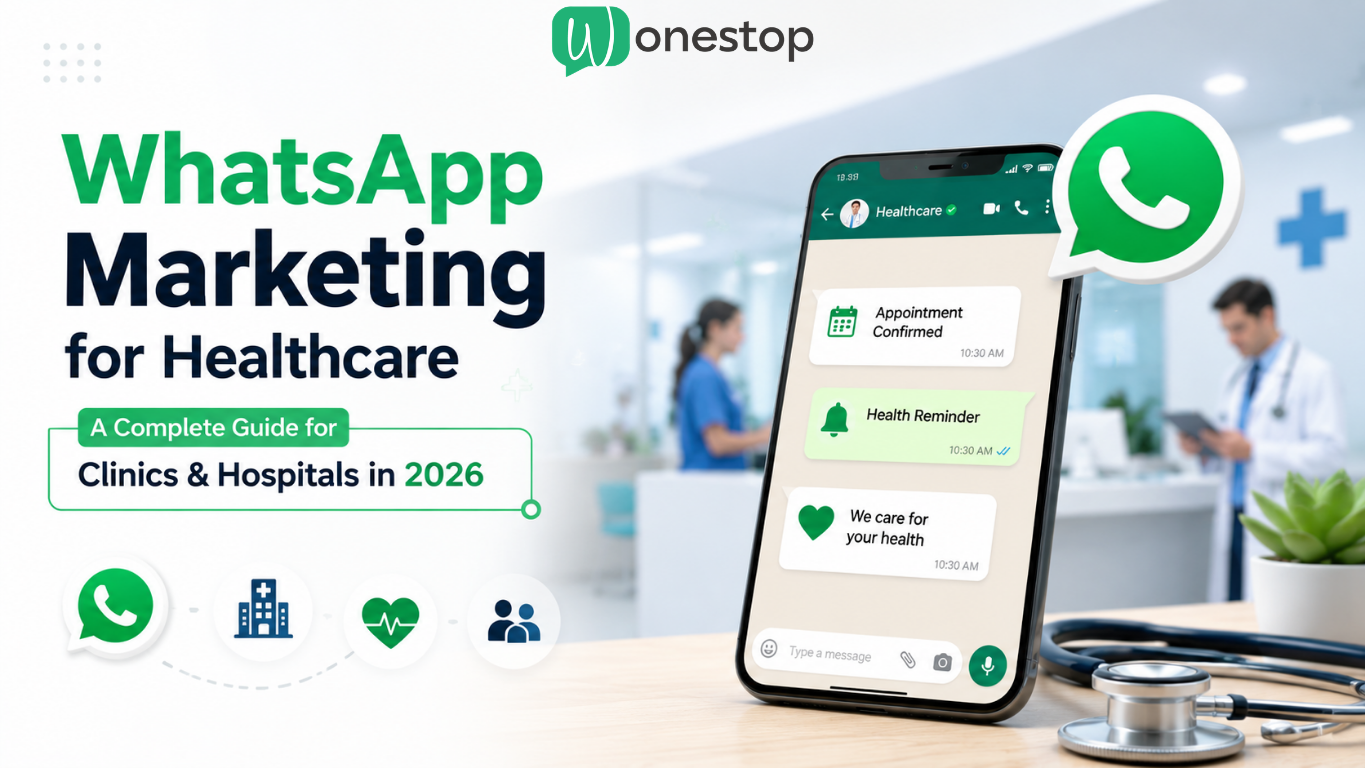
  • WhatsApp Marketing for Healthcare: A Complete Guide for Clinics and Hospitals in 2026

    WhatsApp Marketing for Healthcare: A Complete Guide for Clinics and Hospitals in 2026

    A missed appointment doesn’t just affect clinic schedules; it affects patient care, staff efficiency, and overall patient experience.

    Today, clinics and hospitals face several communication challenges:

    • missed appointments
    • delayed follow-ups
    • overloaded reception teams
    • unanswered patient inquiries
    • long waiting times

    At the same time, patient expectations are changing.

    Patients want:

    • instant appointment confirmations
    • faster responses
    • easy communication
    • quick updates
    • digital convenience

    This is why WhatsApp marketing for healthcare is becoming one of the most effective patient communication channels in 2026.

    Using the official WhatsApp Business API for healthcare, clinics, and hospitals can automate reminders, improve patient engagement, streamline support communication, and reduce operational workload.

    From appointment reminders to patient follow-ups, healthcare providers are now using WhatsApp to create faster, more organized, and more efficient communication systems.

    In this guide, we’ll explain how healthcare businesses can use WhatsApp marketing to improve patient engagement and operational efficiency in 2026.

    Table of Contents

    1. What Is WhatsApp Marketing for Healthcare?
    2. Why Clinics & Hospitals Are Using WhatsApp
    3. Benefits of WhatsApp Business API for Healthcare
    4. Example Patient Journey Using WhatsApp
    5. How WhatsApp Improves Patient Engagement
    6. Real Healthcare Use Cases
    7. WhatsApp Business API vs Regular WhatsApp Business
    8. Operational Benefits for Healthcare Providers
    9. Best Practices for Healthcare WhatsApp Marketing
    10. Common Mistakes to Avoid
    11. Why Healthcare Businesses Choose Wonestop
    12. FAQs
    13. Final Thoughts

    What Is WhatsApp Marketing for Healthcare?

    WhatsApp marketing for healthcare means using WhatsApp to improve communication between healthcare providers and patients.

    Healthcare businesses use WhatsApp for:

    • appointment reminders
    • patient follow-ups
    • consultation bookings
    • prescription reminders
    • lab report notifications
    • patient support
    • wellness campaigns
    • vaccination reminders

    Instead of relying only on phone calls and emails, healthcare providers can communicate with patients through a faster and more convenient channel.

    Since most patients already use WhatsApp daily, communication becomes easier, more accessible, and more responsive.

    Why Clinics & Hospitals Are Using WhatsApp

    Traditional communication methods often create delays and inefficiencies in healthcare operations.

    Common challenges include:

    • missed patient calls
    • unread emails
    • delayed follow-ups
    • high front desk workload
    • scheduling confusion

    This directly impacts:

    • patient experience
    • operational efficiency
    • appointment attendance
    • patient satisfaction

    WhatsApp simplifies communication by allowing patients to:

    • confirm appointments
    • receive reminders
    • ask questions
    • receive updates instantly

    This is why more healthcare providers are adopting WhatsApp Business API for healthcare to improve communication workflows.

    Benefits of WhatsApp Business API for Healthcare

    The official WhatsApp Business API for healthcare helps clinics and hospitals automate and scale patient communication.

    Key benefits include:

    Faster Patient Communication

    Patients receive messages instantly, improving communication speed and responsiveness.

    Reduced Missed Appointments

    Automated reminders help reduce no-shows and improve scheduling efficiency.

    Better Patient Engagement

    Regular follow-ups and reminders help healthcare providers maintain long-term patient relationships

    Reduced Front Desk Workload

    Automation reduces repetitive communication tasks for support and reception teams.

    Improved Operational Efficiency

    Healthcare providers can streamline appointment management, patient support, and communication workflows.

    Example Patient Journey Using WhatsApp

    Appointment Booked


    Instant confirmation message

    24-Hour Reminder


    Appointment reminder and confirmation

    Post Consultation Follow-Up


    Recovery guidance or medicine reminder

    Feedback Collection


    Patient satisfaction feedback request

    Re-engagement Reminder


    Annual check-up or revisit reminder

    This type of automated workflow helps healthcare providers create a smoother and more connected patient experience.

    How WhatsApp Improves Patient Engagement

    1. Appointment Reminder Automation

    One of the biggest healthcare communication challenges is missed appointments.

    Patients often forget consultation timings.

    Instead of manually calling patients, clinics can automate reminders using WhatsApp Business API for healthcare.

    Example Message

    “Hi Sarah, this is a reminder for your appointment tomorrow at 4:00 PM with Dr. Smith.”

    This helps:

    • reduce no-shows
    • improve scheduling efficiency
    • Save staff time

    2. Patient Follow-Ups

    Patient communication should continue even after consultation.

    Healthcare providers can send:

    • medicine reminders
    • recovery instructions
    • follow-up appointment reminders
    • treatment guidance

    Example

    “We hope you’re recovering well. Don’t forget your follow-up appointment this Friday.”

    This improves:

    • patient trust
    • retention
    • treatment adherence

    3. Lab Report Notifications

    Patients frequently contact clinics asking whether reports are ready.

    WhatsApp simplifies this communication.

    Example

    “Your blood test report is now available. Please visit the clinic or access your patient portal.”

    This reduces:

    • Repeated phone calls
    • front desk workload
    • patient frustration

    4. Instant Patient Support

    Patients often ask about:

    • doctor availability
    • clinic timings
    • appointment slots
    • consultation charges
    • clinic locations

    Instead of long phone calls, WhatsApp enables faster support communication.

    5. Health Awareness Campaigns

    Healthcare providers can also use WhatsApp for awareness campaigns.

    Examples include:

    • vaccination reminders
    • preventive healthcare tips
    • wellness campaigns
    • seasonal healthcare alerts

    Example

    “Flu season is here. Book your vaccination appointment today.”

    This helps healthcare businesses maintain patient engagement beyond appointments.

    Real Healthcare Use Cases

    Clinics

    • appointment reminders
    • follow-up communication
    • patient support workflows

    Hospitals

    • patient communication
    • OPD updates
    • scheduling notifications

    Dental Clinics

    • cleaning reminders
    • treatment follow-ups
    • consultation scheduling

    Diagnostic Centers

    • test reminders
    • report notifications
    • appointment confirmations

    Cosmetic Clinics

    • consultation reminders
    • treatment follow-ups
    • patient engagement campaigns

    WhatsApp Business API vs Regular WhatsApp Business

    FeatureRegular WhatsApp BusinessWhatsApp Business API
    Appointment RemindersManualAutomated
    Patient Follow-UpsManualAutomated
    Multi-User AccessLimitedYes
    CRM IntegrationNoYes
    AutomationBasicAdvanced
    ScalabilityLowHigh
    Workflow ManagementLimitedAdvanced

    For growing healthcare providers, the WhatsApp Business API for healthcare offers significantly better scalability and automation.

    Read More: WhatsApp Marketing vs Email Marketing: What Works Better for Businesses?

    Operational Benefits for Healthcare Providers

    Healthcare providers use WhatsApp automation to improve operational efficiency by:

    • reducing front desk workload
    • minimizing missed appointments
    • improving patient response rates
    • streamlining appointment scheduling
    • centralizing patient communication
    • improving support team productivity

    This helps clinics and hospitals create more organized communication systems while improving patient experience.

    Best Practices for Healthcare WhatsApp Marketing

    Keep Messages Short

    Patients prefer clear and concise communication.

    Avoid overly long messages.

    Personalize Communication

    Use patient names and appointment details whenever possible.

    Personalized communication improves engagement.

    Use Automated Reminders

    Automation helps reduce manual workload and improves appointment attendance.

    Avoid Spam

    Only send relevant healthcare communication.

    Too many promotional messages can reduce trust.

    Respect Patient Privacy

    Healthcare providers should always use secure and consent-based communication while handling patient interactions on WhatsApp.

    Use Opt-In Communication

    Always ensure patients consent to receiving WhatsApp updates and reminders.

    Common Mistakes to Avoid

    Sending Too Many Messages

    Overcommunication can frustrate patients and reduce engagement.

    Delayed Responses

    Slow communication negatively impacts patient experience.

    Ignoring Follow-Ups

    Follow-up communication is essential for patient retention and care continuity.

    Using Unorganized Communication Systems

    Without automation and workflows, patient communication can become inconsistent and difficult to manage.

    Why Healthcare Businesses Choose Wonestop

    Healthcare providers need communication systems that are:

    • fast
    • organized
    • scalable
    • reliable

    Wonestop helps clinics, hospitals, diagnostic centers, and healthcare businesses improve patient communication using the official WhatsApp Business API for healthcare solutions.

    Healthcare providers use Wonestop for:

    • appointment reminder automation
    • patient follow-ups
    • CRM integration
    • smart communication workflows
    • multi-agent support
    • patient engagement systems

    Whether you run:

    • a clinic
    • hospital
    • dental practice
    • diagnostic center
    • cosmetic clinic

    Wonestop helps streamline patient communication through WhatsApp automation.

    FAQs

    Is WhatsApp marketing effective for healthcare?

    Yes. WhatsApp helps improve patient communication, engagement, appointment attendance, and operational efficiency.

    Can clinics automate appointment reminders?

    Yes. Clinics can automate reminders using WhatsApp Business API solutions.

    Is WhatsApp useful for hospitals?

    Absolutely. Hospitals use WhatsApp for patient communication, appointment reminders, support workflows, and OPD updates.

    Can WhatsApp improve patient engagement?

    Yes. Faster communication improves patient experience, retention, and engagement.

    Is WhatsApp Business API better than regular WhatsApp Business?

    Yes. WhatsApp Business API offers automation, CRM integration, scalability, and multi-agent access for growing healthcare providers.

    Automate Patient Communication With WhatsApp?

    Whether you run a clinic, hospital, diagnostic center, or healthcare practice, better communication can improve patient experience and reduce missed appointments.

    Wonestop helps healthcare providers automate:

    • appointment reminders
    • patient follow-ups
    • support communication
    • engagement workflows

    using official WhatsApp Business API solutions.

    Talk to Wonestop today and create a smarter patient communication system.

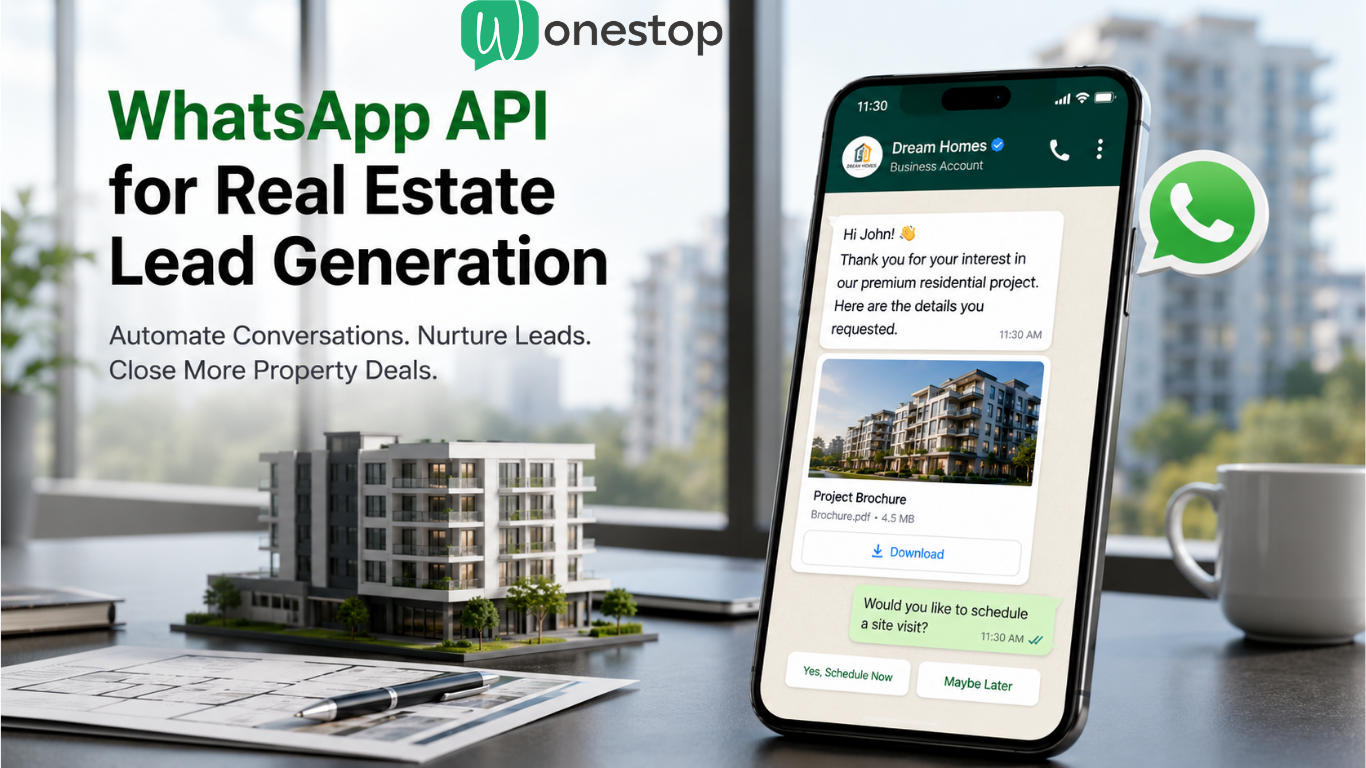
  • WhatsApp API for Real Estate Lead Generation: Complete Guide for Builders and Agents

    WhatsApp API for Real Estate Lead Generation: Complete Guide for Builders and Agents

    Real estate businesses spend thousands of dollars every month on Meta Ads, Google Ads, property portals, landing pages, and digital campaigns to generate inquiries.

    But here’s the truth:

    Getting leads is easy. Converting them is hard.

    Most builders, developers, brokers, and real estate agencies lose potential customers because of:

    • Delayed responses
    • Missed follow-ups
    • Poor lead nurturing
    • Unorganized sales communication
    • Slow site visit scheduling

    In real estate, timing matters.

    If a buyer submits an inquiry and doesn’t receive an instant response, chances are they’ll speak to another developer before your sales team even makes the first call.

    That’s where WhatsApp Business API for real estate lead generation becomes a game-changer.

    With an official WhatsApp Business API solution, real estate businesses can automate conversations, instantly engage inquiries, schedule site visits, nurture leads, and improve conversions, all on WhatsApp.

    In this guide, we’ll explain how the WhatsApp API helps real estate companies generate better leads, improve follow-ups, and increase property sales.

    Why Real Estate Businesses Lose Leads

    Most real estate companies generate inquiries from:

    • Meta Ads
    • Google Ads
    • Property portals
    • Website inquiries
    • Landing pages
    • Channel partner campaigns
    • Social media marketing

    But what happens after the lead comes in?

    Usually this:

    A buyer fills out a property inquiry form.

    Then:

    ❌ Sales executive responds after several hours
    ❌ Lead already contacted competitors
    ❌ Brochure sharing gets delayed
    ❌ Follow-ups are missed
    ❌ Site visit never happens
    ❌ Lead becomes cold

    This is one of the biggest problems in real estate sales.

    Whether it’s residential apartments, luxury villas, commercial spaces, plotted developments, or pre-launch projects:

    The business that responds first usually wins the lead.

    This is why many real estate businesses are now switching to WhatsApp automation for real estate lead generation.

    What Is WhatsApp Business API for Real Estate?

    WhatsApp Business API is an advanced communication solution that helps real estate companies automate conversations and manage leads at scale.

    Unlike normal WhatsApp Business, an official WhatsApp Business API platform allows businesses to:

    ✅ Send instant responses
    ✅ Share brochures automatically
    ✅ Schedule site visits
    ✅ Automate lead nurturing
    ✅ Route leads to sales teams
    ✅ Integrate with CRM systems
    ✅ Run WhatsApp campaigns
    ✅ Manage large inquiry volumes

    This helps builders, brokers, developers, and property consultants handle customer inquiries faster and more professionally.

    How WhatsApp API Helps Real Estate Lead Generation

    1. Instant Lead Response

    In real estate:

    Speed = conversions

    Imagine someone clicks your ad and submits an inquiry.

    Instead of waiting for a callback, the customer instantly receives:

    “Hi John, thank you for your interest in our premium residential project. Here’s the brochure, floor plan, pricing, and project details.”

    Within seconds.

    This instantly improves:

    • customer trust
    • engagement
    • response rate
    • conversion probability

    Example Workflow

    Meta Ad → Inquiry Form → Instant WhatsApp Message → Brochure Shared → Sales Assigned → Site Visit Scheduled

    Simple.

    But extremely effective.

    2. Automated Property Brochure Sharing

    One of the most repetitive tasks for sales teams is sending:

    • brochures
    • pricing sheets
    • floor plans
    • amenities list
    • master plans
    • location maps
    • possession details

    Doing this manually wastes time.

    With WhatsApp API automation for real estate, businesses can instantly send project information without manual effort.

    Benefits

    ✔ Faster communication
    ✔ Better customer experience
    ✔ Reduced response delays
    ✔ More professional sales process

    3. Site Visit Booking Automation

    The biggest goal of most property campaigns is:

    Getting the customer to visit the site.

    WhatsApp automation makes this easier.

    Example Workflow

    New inquiry → Auto response → Property details shared → Preferred visit date selected → Confirmation message → Reminder notification

    Customers can quickly book:

    • Site visits
    • Property consultations
    • Sales office meetings
    • Virtual property tours

    Automated reminders also reduce no-shows.

    4. Automated Lead Nurturing on WhatsApp

    Most buyers don’t buy immediately.

    Some decide in:

    • 15 days
    • 30 days
    • 60 days
    • even several months

    Without follow-ups:

    Leads disappear.

    With WhatsApp lead nurturing, real estate companies can stay connected automatically.

    Example Follow-Up Sequence

    Day 1

    Project brochure + pricing

    Day 3

    Amenities & location advantages

    Day 7

    Inventory update

    Day 15

    Special offer or payment plan

    Day 30

    Customer testimonial or project update

    This keeps your project in front of buyers consistently.

    WhatsApp API vs Traditional Real Estate Follow-Ups

    FeatureTraditional Follow-UpWhatsApp API Automation
    Response TimeSlowInstant
    Brochure SharingManualAutomated
    Follow-UpsOften MissedAutomated
    Site Visit SchedulingManual CallsAutomated
    Lead TrackingWeakCentralized
    CRM IntegrationDifficultEasy
    Team CollaborationLimitedMulti-Agent

    For growing real estate businesses:

    Automation is no longer optional.

    It’s becoming necessary.

    How Different Real Estate Businesses Use WhatsApp API

    Builders & Developers

    Launch announcements, project updates, and site visit scheduling.

    Real Estate Brokers

    Instant inquiry handling and lead nurturing.

    Luxury Real Estate Brands

    VIP communication and personalized engagement.

    Commercial Property Consultants

    Handling large inquiry volumes efficiently.

    NRI Property Consultants

    International follow-ups for overseas buyers.

    Channel Partners

    Managing project communication and inventory updates.

    Click-to-WhatsApp Ads for Property Leads

    Many real estate businesses are moving to Click-to-WhatsApp Ads.

    Instead of sending traffic to long forms:

    Ads directly open WhatsApp.

    Why It Works

    ✅ Faster engagement
    ✅ Higher response rate
    ✅ Better lead quality
    ✅ Lower drop-offs
    ✅ Direct conversations

    Especially effective for:

    • Luxury projects
    • Pre-launch campaigns
    • NRI property marketing
    • Commercial real estate

    Why Regular WhatsApp Business Is Not Enough

    Many builders still rely on the normal WhatsApp Business.

    But once inquiry volume increases:

    Problems start.

    Limitations of Regular WhatsApp

    ❌ No advanced automation
    ❌ No CRM integration
    ❌ Limited team access
    ❌ Weak lead tracking
    ❌ No chatbot workflows
    ❌ Hard to scale

    An official WhatsApp Business API provider helps businesses manage customer communication professionally.

    Best Practices for Real Estate WhatsApp Marketing

    Respond instantly

    Fast replies increase conversions.

    Keep messages short

    People don’t read long messages.

    Share brochures quickly

    Reduce waiting time.

    Automate follow-ups

    Don’t rely only on manual sales.

    Use Click-to-WhatsApp Ads

    Start conversations faster.

    Track every lead

    Understand what converts.

    Personalize communication

    Based on buyer interest and budget.

    Why Real Estate Companies Across USA, UAE, UK & Other Markets Are Adopting WhatsApp API

    Real estate businesses in countries like:

    • USA
    • UAE
    • UK
    • Canada
    • Australia
    • Singapore

    are increasingly using WhatsApp Business API for real estate marketing because buyers prefer messaging over calls.

    Customers usually:

    • Check WhatsApp faster
    • Reply quickly
    • Share brochures with family
    • Save pricing & floor plans easily

    This makes WhatsApp one of the strongest channels for property lead nurturing.

    Why Choose Wonestop for Real Estate WhatsApp API?

    At Wonestop, we help real estate businesses automate communication and improve lead conversion using official WhatsApp Business API solutions.

    We help with:

    ✅ WhatsApp Business API setup
    ✅ CRM integration
    ✅ Lead routing automation
    ✅ Site visit workflows
    ✅ Bulk messaging campaigns
    ✅ Multi-agent access
    ✅ Automated follow-ups
    ✅ Real-time customer engagement

    Whether you are a builder, broker, developer, or real estate consultant, Wonestop helps you build a smarter sales process.

    FAQs

    1. Is WhatsApp API good for real estate lead generation?

    Yes. WhatsApp API helps real estate companies automate responses, improve follow-ups, and increase site visit bookings.

    2. Can builders automate property inquiries using WhatsApp?

    Absolutely. Builders can automate brochure sharing, FAQs, site visits, and customer communication.

    3. Is WhatsApp API better than regular WhatsApp Business?

    Yes. WhatsApp Business API supports automation, CRM integration, multi-agent access, and advanced lead nurturing.

    4. Can WhatsApp API integrate with CRM software?

    Yes. Real estate businesses can connect the WhatsApp API with CRM systems to track leads and automate workflows.

    5. Is WhatsApp marketing effective for real estate businesses?

    Very effective. It improves customer engagement, lead nurturing, and conversion rates.

    6. Which is the best WhatsApp API provider for real estate?

    The best provider depends on your automation, CRM, and campaign needs. Businesses looking for scalable automation often prefer official providers that support workflows and lead management.

    Looking to Automate Real Estate Lead Generation on WhatsApp?

    If your real estate business is generating leads but struggling with delayed follow-ups and missed conversions, it’s time to automate.

    Wonestop helps builders, developers, brokers, and agencies set up official WhatsApp Business API solutions to improve lead response, automate follow-ups, and increase site visit bookings.

    Talk to Wonestop today and turn more property inquiries into real sales.

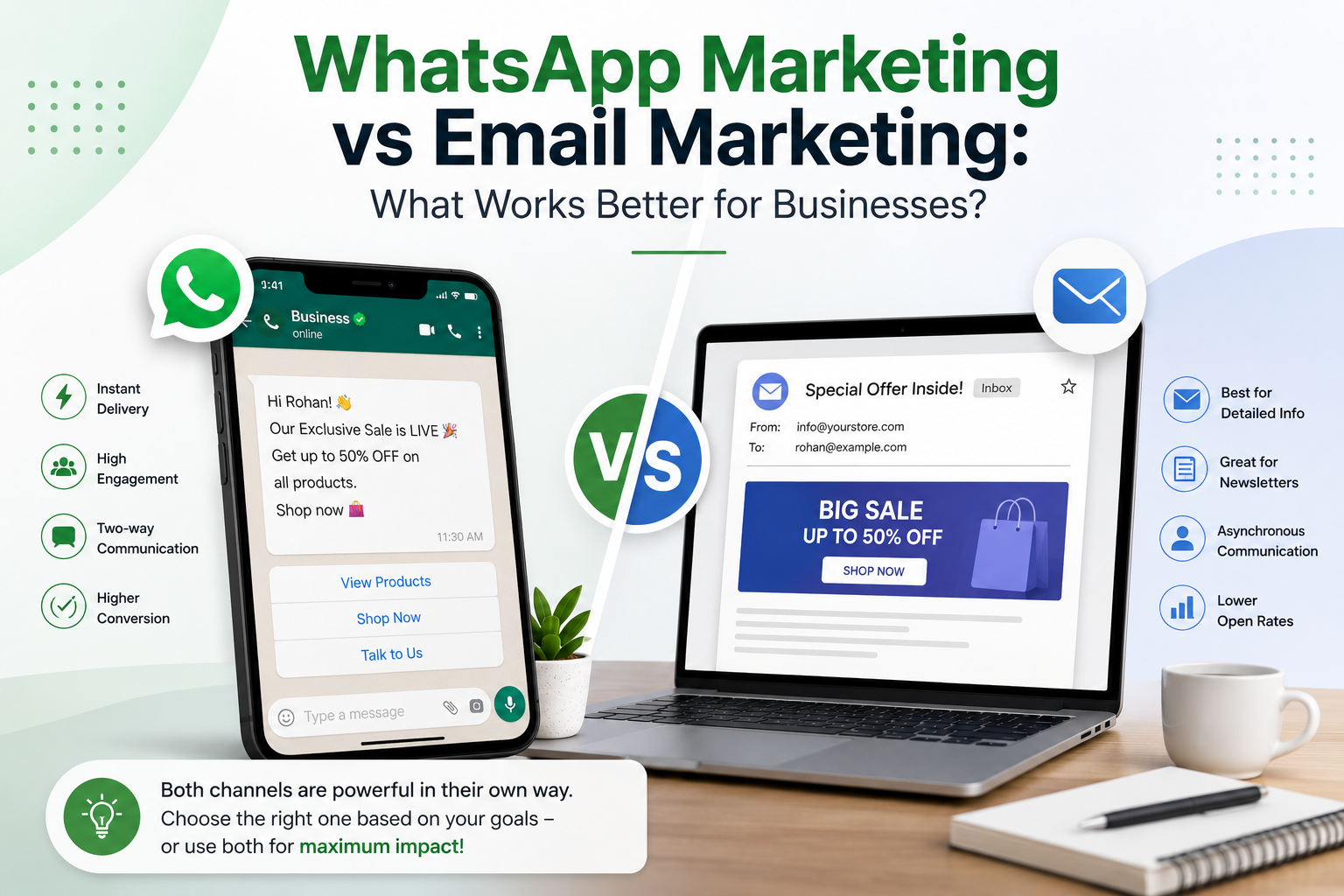
  • WhatsApp Marketing vs Email Marketing: What Works Better for Businesses?

    WhatsApp Marketing vs Email Marketing: What Works Better for Businesses?

    Most businesses are facing the same problem today.

    Customers scroll past promotional emails without opening them, but reply to WhatsApp messages within minutes. Inbox fatigue is growing, attention spans are shorter, and businesses are under pressure to communicate faster than ever.

    This shift in customer behavior has changed how brands approach digital communication.

    While email marketing still plays an important role, WhatsApp marketing is becoming one of the fastest-growing customer engagement channels for businesses. From e-commerce brands and startups to service providers and local businesses, companies are now using messaging platforms to create faster, more direct customer conversations.

    So which one actually works better?

    The answer depends on what your business wants to achieve.

    If you want detailed communication and long-term nurturing, email marketing still has value. But if your goal is instant engagement, faster responses, and better customer interaction, WhatsApp marketing often delivers stronger results.

    Let’s break down both channels properly and understand where each one works best.

    What is WhatsApp Marketing?

    WhatsApp marketing is the process of communicating with customers through WhatsApp using promotional messages, updates, reminders, support chats, and automated conversations.

    Unlike traditional marketing channels, WhatsApp feels personal. Messages arrive directly on a customer’s phone, which naturally increases visibility and engagement.

    Businesses commonly use WhatsApp marketing for:

    • Order updates
    • Appointment reminders
    • Promotional campaigns
    • Customer support
    • Lead nurturing
    • Product recommendations
    • Cart recovery
    • Feedback collection

    With WhatsApp Business API and automation tools, businesses can now handle customer communication at scale while still maintaining personalized interactions.

    This is one of the biggest reasons why WhatsApp business marketing is growing rapidly across industries.

    What is Email Marketing?

    Email marketing is a digital marketing strategy where businesses send emails to subscribers or customers for promotions, updates, newsletters, educational content, and sales communication.

    For years, email marketing has been one of the most reliable channels for customer retention and lead nurturing.

    Businesses use email marketing for:

    • Newsletters
    • Product launches
    • Educational content
    • Business updates
    • Promotional campaigns
    • Customer onboarding
    • Reports and invoices

    Email works especially well when businesses need to share detailed information in a structured format.

    Even today, email marketing for businesses remains effective for B2B communication, long-form content, and relationship building.

    WhatsApp Marketing vs Email Marketing: Key Differences

    Both platforms are useful, but they work differently depending on customer behavior and communication goals.

    FeatureWhatsApp MarketingEmail Marketing
    Open RatesExtremely highModerate
    Response SpeedFastSlower
    Customer EngagementMore interactiveLower interaction
    PersonalizationHighly personalModerately personalized
    AutomationReal-time automationWorkflow automation
    Conversion PotentialStrong for instant actionBetter for long-term nurturing
    Customer SupportExcellentLimited
    Best Use CasesPromotions, reminders, supportNewsletters, reports, education

    Which Channel Gets Better Open Rates?

    WhatsApp marketing generally gets much higher open rates than email marketing.

    Most people check WhatsApp several times throughout the day, while emails often remain unread for hours or even days.

    Industry studies regularly show that WhatsApp messages can achieve open rates above 90%, while average email open rates are significantly lower.

    That difference matters because visibility directly affects conversions.

    For example:

    • A restaurant sending a lunch offer on WhatsApp may get immediate bookings.
    • The same offer through email may stay unopened in a crowded inbox.

    This is one reason businesses are shifting toward conversational marketing channels.

    Which Platform Generates Faster Customer Responses?

    WhatsApp clearly performs better for response speed.

    Customers naturally treat WhatsApp as a real-time communication platform. Emails, on the other hand, are often checked less frequently.

    Businesses that depend on fast interaction usually see better engagement through WhatsApp.

    This includes:

    • E-commerce brands
    • Healthcare clinics
    • Real estate companies
    • Education providers
    • Local service businesses

    For example, a customer asking about product availability on WhatsApp is more likely to continue the conversation immediately compared to email communication.

    Faster responses also improve sales opportunities.

    Why Businesses Are Moving Toward WhatsApp Marketing

    Businesses today want communication channels that feel natural, quick, and customer-friendly.

    That is exactly why WhatsApp marketing is growing so fast.

    Customers Prefer Instant Communication

    Modern customers do not want delayed responses. They expect businesses to reply quickly, especially on mobile devices.

    WhatsApp helps businesses meet those expectations.

    Better Mobile Engagement

    Most online traffic now comes from smartphones. Since WhatsApp is already part of daily mobile behavior, engagement rates tend to be stronger.

    Personalized Conversations

    WhatsApp messages feel more human compared to promotional emails.

    Businesses can:

    • Send personalized offers
    • Share product recommendations
    • Follow up on inquiries
    • Provide support instantly

    This creates stronger customer relationships.

    WhatsApp Automation Makes Scaling Easier

    Businesses can now automate:

    • Welcome messages
    • Cart recovery reminders
    • Order confirmations
    • Customer support replies
    • Lead qualification

    Modern customer engagement platforms like Wonestop help businesses automate communication while maintaining personalized customer experiences.

    When Email Marketing Still Works Better

    Even though WhatsApp marketing is growing rapidly, email marketing still works well in many situations.

    Long-Form Content

    Emails are better for:

    • Detailed guides
    • Newsletters
    • Reports
    • Case studies
    • Educational content

    WhatsApp works best for shorter communication.

    Professional Communication

    Formal business communication is still more trusted through email, especially in B2B industries.

    Large-Scale Campaigns

    Email platforms are effective for managing massive subscriber lists and scheduled campaigns.

    Lead Nurturing

    Email sequences are useful for moving leads through longer sales cycles.

    For example, SaaS businesses often rely heavily on email onboarding campaigns to educate users gradually.

    Best Marketing Strategy for Small Businesses

    For small businesses, communication efficiency matters more than ever.

    Most small businesses cannot afford to lose customer attention through slow or ineffective communication.

    That is why many small brands now prefer WhatsApp marketing for:

    • Faster replies
    • Direct engagement
    • Personalized communication
    • Better customer retention

    A local salon can use WhatsApp reminders to reduce missed appointments.

    An e-commerce store can recover abandoned carts through quick WhatsApp follow-ups.

    A coaching business can answer inquiries instantly without lengthy email exchanges.

    Small businesses usually benefit more from speed and engagement than complex communication systems.

    Can Businesses Use WhatsApp and Email Marketing Together?

    Yes — and this is often the smartest strategy.

    Businesses do not need to choose one channel over the other. The strongest communication strategies combine both platforms.

    Here’s a practical example:

    Use Email Marketing For:

    • Newsletters
    • Educational content
    • Product updates
    • Long-form communication

    Use WhatsApp Marketing For:

    • Instant updates
    • Customer support
    • Promotions
    • Follow-ups
    • Appointment reminders
    • Cart recovery

    This multi-channel approach improves customer experience while increasing engagement opportunities.

    WhatsApp Marketing Benefits Businesses Should Not Ignore

    Businesses moving toward conversational communication are seeing several advantages.

    Higher Visibility

    WhatsApp messages are more likely to be seen quickly.

    Faster Decision-Making

    Customers respond faster when communication feels direct and simple.

    Better Customer Experience

    Real-time support improves trust and satisfaction.

    Stronger Conversion Potential

    Quick engagement often leads to quicker conversions.

    Better Retention

    Personalized conversations help businesses stay connected with customers longer.

    Final Verdict: Which One Should Businesses Choose?

    There is no single winner because both channels solve different communication problems.

    Email marketing still works well for long-form content, educational campaigns, and formal communication. It remains useful for nurturing leads and maintaining professional relationships.

    However, customer behavior is clearly shifting toward faster and more interactive communication platforms.

    WhatsApp marketing offers:

    • Better engagement
    • Faster responses
    • Stronger visibility
    • More personal interaction
    • Better mobile communication

    For most modern businesses, the best approach is to use both strategically.

    Businesses that combine instant communication with long-term nurturing usually build stronger customer relationships and improve conversions more effectively.

    As customer expectations continue changing, communication speed and personalization will become even more important.

    Platforms like Wonestop help businesses simplify customer communication through WhatsApp automation, smarter engagement tools, and modern messaging solutions designed for how customers interact today.

    FAQs

    Is WhatsApp marketing better than email marketing?

    WhatsApp marketing is often better for instant engagement, faster responses, and customer interaction, while email marketing works better for detailed communication and long-term nurturing.

    What are the benefits of WhatsApp marketing?

    WhatsApp marketing benefits include higher open rates, faster customer replies, better personalization, real-time communication, and stronger mobile engagement.

    Does email marketing still work in 2026?

    Yes. Email marketing still works well for newsletters, educational content, business communication, and automated lead nurturing campaigns.

    Which platform gives faster customer responses?

    WhatsApp usually generates faster customer responses because users check messages more frequently than emails.

    Can businesses use WhatsApp and email marketing together?

    Yes. Many businesses use email marketing for long-form communication and WhatsApp marketing for instant updates, customer support, and promotions.

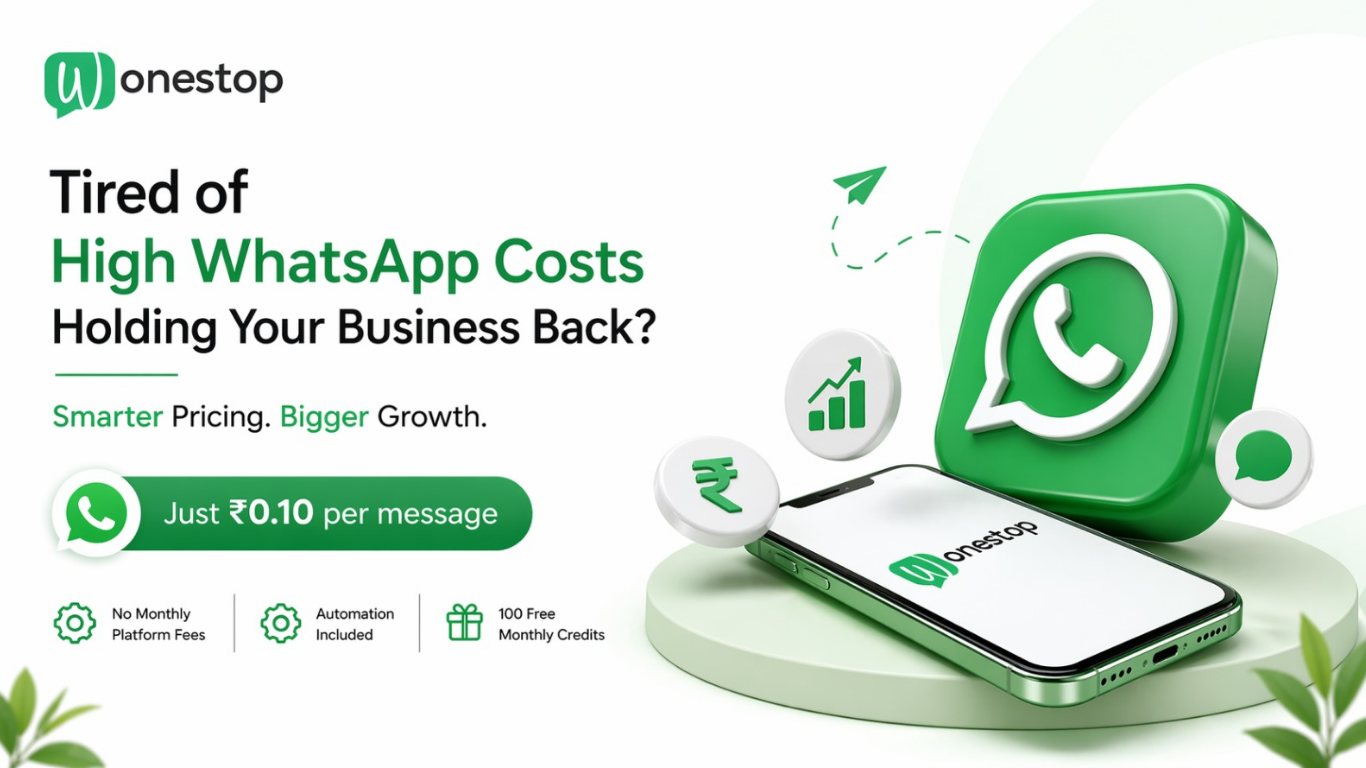
  • Tired of High WhatsApp Costs? Wonestop Offers ₹0.10 Per Message with Zero Monthly Platform Fees

    Tired of High WhatsApp Costs? Wonestop Offers ₹0.10 Per Message with Zero Monthly Platform Fees

    Businesses today rely on WhatsApp for lead generation, customer support, OTP alerts, promotions, appointment reminders, and customer engagement. But many companies still overpay through expensive subscriptions, hidden charges, and complex pricing plans.

    Wonestop offers a smarter solution with ₹0.10 per message pricing, zero monthly platform fees, 100 free monthly credits, and no hidden charges.

    Businesses only pay a one-time setup charge to get started, then pay just ₹0.10 per message based on actual usage.

    If your business wants affordable WhatsApp automation with predictable costs, Wonestop is built to help you grow.

    Quick Answer: What Is Wonestop Pricing?

    Wonestop offers a transparent WhatsApp business messaging model that includes

    FeatureWonestop
    Setup FeeOne-time
    Monthly Platform Fee₹0
    Per Message Cost₹0.10
    Free Credits100 Monthly
    Hidden ChargesNo
    Automation ToolsIncluded

    This pricing model is ideal for startups, SMEs, e-commerce brands, agencies, and growing businesses.

    Why Businesses Are Tired of Expensive WhatsApp Platforms

    Many companies choose a messaging platform and later discover:

    • High recurring monthly fees
    • Per-message costs that keep changing
    • Extra charges for automation tools
    • Hidden onboarding fees
    • Poor support after signing up
    • Low ROI on campaigns

    For growing businesses, these costs reduce profitability and slow expansion.

    That’s why transparent pricing matters more than ever.

    How Wonestop Helps Reduce WhatsApp Costs

    Wonestop is designed for businesses that want to scale communication without unnecessary expenses.

    Key Benefits:

    • ₹0.10 fixed per-message pricing
    • Zero monthly platform fee
    • 100 free credits every month
    • No hidden charges
    • One-time setup fee only
    • Easy onboarding
    • Business automation tools included

    This means you pay for actual usage, not inflated subscriptions.

    Built for Lead Generation and Business Growth

    Affordable pricing is valuable, but results matter more.

    Wonestop helps businesses:

    • Respond faster to leads
    • Automate follow-ups
    • Run WhatsApp promotions
    • Recover lost prospects
    • Send OTP and alerts instantly
    • Improve customer retention
    • Increase repeat sales

    For many businesses, faster communication directly improves conversions.

    Best for Which Businesses?

    E-commerce Stores

    Send offers, COD confirmations, shipping updates, cart recovery reminders, and customer support replies.

    Real Estate Companies

    Automate inquiry responses, follow-ups, site visit reminders, and project updates.

    Education Institutes

    Admissions support, notices, fee reminders, and student engagement.

    Clinics & Healthcare

    Appointment reminders, confirmations, and patient communication.

    Agencies & Service Businesses

    Lead nurturing, campaign messaging, support automation, and client engagement.

    More Than Low Pricing: Full WhatsApp Automation Platform

    Wonestop also gives businesses access to growth-focused tools:

    • Bulk WhatsApp campaigns
    • OTP messaging
    • Utility notifications
    • Chat automation
    • Shared team inbox
    • CRM integrations
    • Analytics and reporting
    • Contact segmentation
    • Customer support workflows

    This creates one platform for sales, support, and marketing communication.

    Wonestop vs Traditional WhatsApp Platforms

    FeatureTraditional PlatformsWonestop
    Monthly Fee₹2,000+ Often Common₹0
    Message CostVariable₹0.10 Fixed
    Hidden ChargesSometimesNo
    Free CreditsLimited / None100 Monthly
    Pricing SimplicityComplexTransparent

    Businesses that value predictable costs often prefer simpler pricing models.

    Why Transparent Pricing Improves ROI

    When pricing is clear, businesses can plan campaigns better.

    Instead of paying large fixed subscriptions every month, companies can:

    • Budget accurately
    • Scale campaigns gradually
    • Improve campaign profitability
    • Test promotions with lower risk
    • Invest more in customer acquisition

    That’s why usage-based pricing is becoming popular.

    Why Businesses Choose Wonestop

    Wonestop focuses on what modern businesses need most:

    • Affordable WhatsApp messaging
    • Transparent billing
    • Lead generation support
    • Easy onboarding
    • Growth-ready automation
    • Better ROI potential
    • Reliable business communication tools

    Ready to Calculate Your Savings?

    If your business is tired of high WhatsApp costs, confusing subscriptions, or hidden charges, Wonestop offers a practical alternative.

    Explore pricing, features, and business automation tools with Wonestop and see how much your business can save.

    Frequently Asked Questions

    What is Wonestop pricing?

    Wonestop includes a one-time setup fee, ₹0.10 per message pricing, zero monthly platform fees, and 100 free monthly credits.

    Is there a monthly subscription fee?

    No, Wonestop offers zero monthly platform fees.

    What do businesses pay first?

    Businesses only pay a one-time setup fee to activate the platform; then, message charges apply based on usage.

    Who should use Wonestop?

    Startups, SMEs, e-commerce stores, agencies, healthcare businesses, education institutes, and enterprises.

    Does Wonestop support automation?

    Yes, businesses can use campaigns, workflows, inbox tools, and customer communication automation.

    Final Thoughts

    Businesses no longer need to overpay for WhatsApp communication tools.

    With a one-time setup charge, ₹0.10 per message, zero monthly platform fees, 100 free monthly credits, and no hidden charges, Wonestop provides an affordable way to automate conversations, generate leads, and grow through WhatsApp.

  • How Businesses Generate High-Quality Leads Using WhatsApp (And Why Most Are Doing It Wrong)

    How Businesses Generate High-Quality Leads Using WhatsApp (And Why Most Are Doing It Wrong)

    Most businesses today are facing the same problem:

    You’re running ads.
    Your website is getting traffic.
    People click… but the leads are either low quality, unresponsive, or completely disappear.

    This isn’t a traffic issue.
    It’s a conversion issue.

    Modern customers don’t want long forms, delayed email replies, or boilerplate sales calls. They want:

    • Instant responses
    • Real conversations
    • Zero friction

    That’s exactly why companies using WhatsApp for lead generation the right way are closing fewer leads, but far better, high-intent ones.

    Let’s break down why WhatsApp lead generation works so well and how businesses can use it to consistently attract ready-to-buy customers.

    Why Traditional Lead Generation Fails Today

    The old funnel looks like this:

    1. User fills out a form
    2. Waits hours (or days) for someone to respond
    3. Gets a generic sales pitch
    4. Loses interest

    This results in:

    • Low response rates
    • Poor-quality leads
    • High ad spend
    • Sales teams chasing uninterested prospects

    Customers don’t want to “be contacted later.”
    They want answers right now.

    WhatsApp solves this by turning lead generation into a real-time conversation instead of a slow, outdated process.

    Why WhatsApp Generates Higher-Quality Leads

    Whether you’re using WhatsApp Marketing, WhatsApp lead generation ads, or a simple website CTA, one thing is consistent:

    People open WhatsApp instantly.

    Here’s why WhatsApp leads outperform web forms and email:

    • Conversations feel personal
    • Intent is visible from the first message
    • The customer is already engaged
    • Real-time chat builds trust faster
    • No friction → higher conversions

    When someone messages you on WhatsApp, they are not “just checking.”

    They are interested, and that alone filters out low-quality leads.

    The Secret: Stop Asking for Leads—Start Conversations

    Most businesses treat WhatsApp like an inbox.

    High-performing businesses treat WhatsApp like a conversation funnel.

    Instead of:

    “Fill this form to know more.”

    Smart businesses use:

    “Chat with us on WhatsApp for instant assistance.”

    This approach eliminates hesitation and attracts people who truly want information—not those who are casually browsing.

    Real Example: How a Small Change Increased Lead Quality by 3x

    A service business was generating website traffic through Facebook Ads, but

    • Lead quality was poor
    • Many prospects only filled out forms to “check prices.”
    • Sales calls went unanswered

    They replaced the form with a “Chat on WhatsApp” button.

    When users clicked, WhatsApp opened with a pre-filled message:

    “Hi, I’m interested in your services and would like more details.”

    The team responded instantly and asked:

    “Can you tell us more about your business and what you’re trying to achieve?”

    Only serious customers continued the chat.

    Results:

    • Lead quality improved dramatically
    • Conversions became faster
    • Follow-ups reduced
    • The sales team saved hours per week

    This is what happens when you replace data collection with conversation.

    How to Qualify Leads on WhatsApp Without Sounding Robotic

    Lead qualification doesn’t require a sales script.
    It requires natural conversation.

    Smart qualifying questions include:

    • “What kind of business do you run?”
    • “What problem are you trying to solve right now?”
    • “When are you planning to start?”

    These feel like a human conversation—not an interrogation.

    By the time your sales team steps in, they already know:

    • Customer need
    • Budget direction
    • Intent level
    • Timeline

    That’s how WhatsApp increases lead quality, not just lead count.

    Why Personal WhatsApp Conversations Build Trust Faster

    People trust people, not websites and not ads.

    WhatsApp allows you to:

    • Address customers by name
    • Respond with context
    • Share voice notes
    • Send short explainer videos
    • Provide solutions in real time

    A short, helpful WhatsApp message often performs better than a polished email sequence.

    When customers feel heard, they convert faster.

    Using WhatsApp Content to Educate (Not Hard-Sell)

    Winning businesses focus on helping first, selling later.

    You can share:

    • PDFs/brochures
    • Quick product demos
    • Case studies
    • Price guides
    • Short explanatory messages

    Instead of:

    “Buy now.”

    Use:

    “Here’s how this solves your problem.”

    That’s how you turn WhatsApp into a high-intent lead engine.

    Follow-Ups That Feel Natural, Not Pushy

    Most leads don’t convert instantly.
    WhatsApp follow-ups work because they feel personal.

    Examples:

    • “Just checking in, does this solution work for you?”
    • “Let me know if you want help choosing the best option.”

    No pressure.
    Just clarity.
    That’s why WhatsApp follow-ups convert so well.

    Final Takeaway: WhatsApp Is Not a Tool — It’s a Strategy

    Businesses that win with WhatsApp don’t treat it as just a messaging app.
    They use it as a relationship-building channel.

    When done right, WhatsApp helps you:

    • Attract high-intent leads
    • Reduce wasted ad spend
    • Shorten your sales cycle
    • Build trust instantly
    • Increase conversion rates

    If your goal is better-quality leads, not more noise, WhatsApp is no longer optional.
    It’s essential.

    FAQs

    1. Is WhatsApp effective for lead generation?

    Yes. WhatsApp leads are significantly higher quality because customers initiate real, direct conversations instead of filling forms and disappearing.

    2. Why are WhatsApp leads better than form leads?

    Form leads have low intent and low engagement. WhatsApp leads show instant interest, ask real questions, and convert faster.

    3. Can small businesses use WhatsApp for marketing?

    Absolutely. WhatsApp Business is ideal for small and local businesses to build trust, explain services, and close leads quickly.

    4. How can I improve lead quality using WhatsApp?

    Use conversational CTAs, respond quickly, ask smart qualifying questions, and share helpful content.

    5. Do WhatsApp ads improve conversion rates?

    Yes. “Click to WhatsApp” ads reduce friction, making it easier for users to start a conversation with your business instantly.

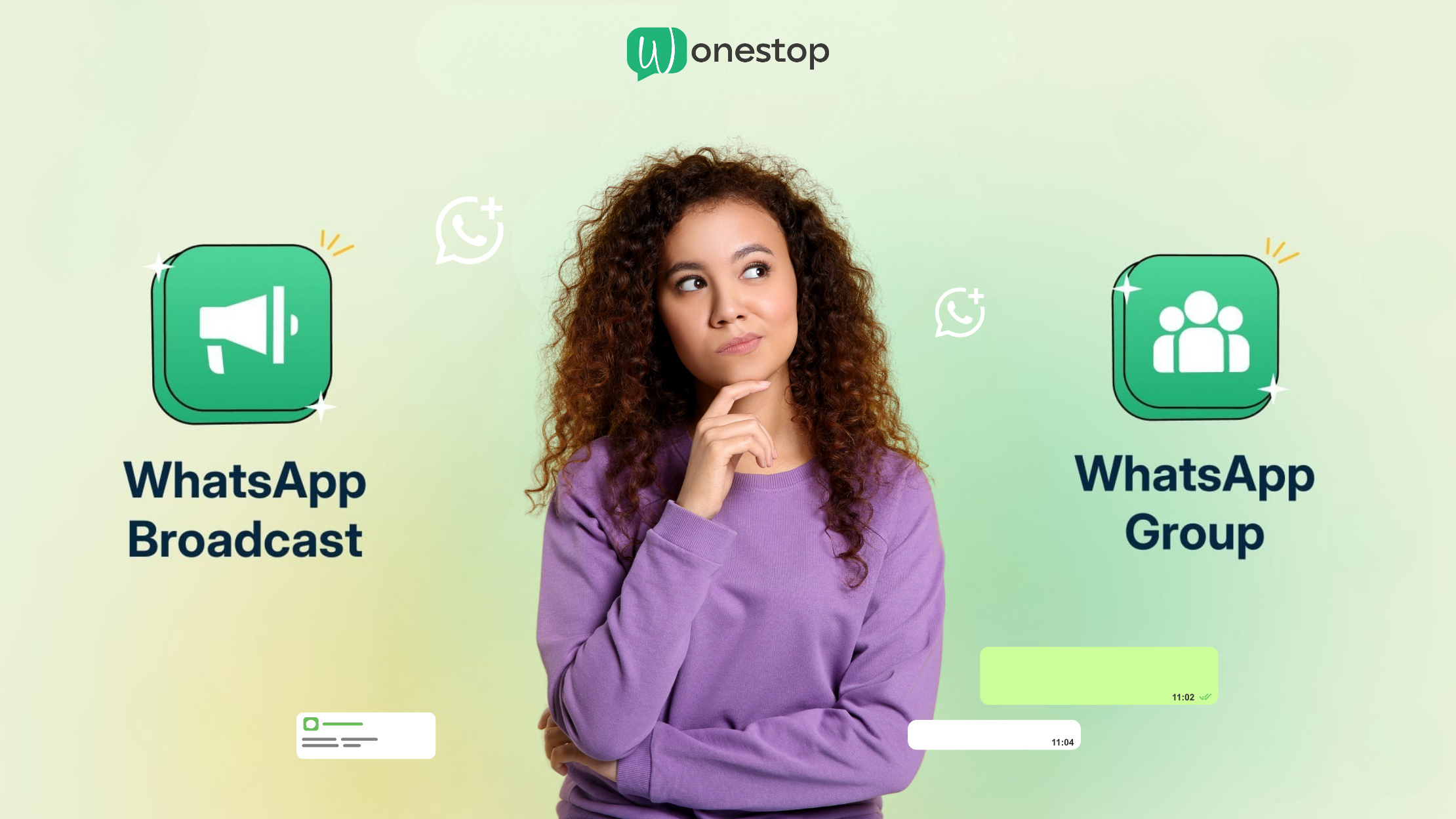
  • WhatsApp Broadcast vs. WhatsApp Group: Which One Should Your Business Really Use?

    WhatsApp Broadcast vs. WhatsApp Group: Which One Should Your Business Really Use?

    Let’s start with something real.

    Think about the last WhatsApp message you actually opened and read carefully.
    Chances are, it was a personal message, not a noisy group notification with 47 unread replies.

    Now pause for a second: That simple habit explains why WhatsApp works so well for business marketing… and also why many businesses fail to use it properly.

    At Wonestop, we often hear:

    “We’re using WhatsApp, but it’s not giving results.”

    Most of the time, the issue isn’t WhatsApp.
    It’s choosing the wrong way to communicate, Broadcast or Group, without understanding the difference.

    Let’s clear that confusion once and for all.

    Why WhatsApp Has Become a Business Essential

    WhatsApp feels personal.
    It’s where customers talk to family, friends, and close contacts, so when a business shows up there, it needs to be careful.

    Used correctly, WhatsApp helps you:

    • Reach customers instantly
    • Build trust faster than emails or ads
    • Get quick responses
    • Increase repeat sales

    Used incorrectly, it gets muted… or worse, blocked.

    That’s why choosing between WhatsApp Broadcast and WhatsApp Group is not a small decision; it directly impacts your brand image.

    What Is WhatsApp Broadcast?

    A WhatsApp Broadcast allows you to send the same message to multiple people individually.

    Each customer receives your message as a private chat, just like a normal WhatsApp message.
    They don’t see other recipients. They don’t get distracted by replies from others.

    Example:

    A salon sends:

    “Hi, we have a weekend offer: 20% off on all services. Would you like to book?”

    It feels personal. Direct. Respectful.

    Why WhatsApp Broadcast Works So Well for Business Marketing

    1. Customers Don’t Feel Disturbed

    Broadcast messages deliver your update clearly, without interruptions from unrelated messages. Customers read what matters and respond when interested.

    2. Your Message Actually Gets Noticed

    Unlike group messages that get buried, broadcast messages sit clearly in the chat list, making them harder to ignore.

    3. Perfect for Promotions and Updates

    Broadcasts are ideal for:

    • Offers and discounts
    • New product launches
    • Order updates
    • Appointment reminders
    • Important announcements

    4. You Stay in Full Control

    Only you send messages. Conversations stay clean and professional.

    This is exactly why many sales-driven businesses prefer WhatsApp Broadcast over groups.

    The Honest Limitations of WhatsApp Broadcast

    To keep things real, here are a few things businesses should know:

    • Customers must save your number to receive messages
    • There are contact limits on normal WhatsApp
    • Automation is limited without advanced tools

    That’s why growing businesses often move to WhatsApp Business API, something Wonestop helps set up properly.

    What Is a WhatsApp Group?

    A WhatsApp Group is a shared space where everyone can talk to everyone.

    Messages are visible to all members, and conversations flow freely.

    This can be powerful, but only in the right context.

    When WhatsApp Groups Actually Make Sense

    Group work is best when your goal is interaction, not selling.

    They’re useful for:

    • Coaching or training batches
    • Customer communities
    • Paid membership groups
    • Internal teams
    • Support or discussion forums

    In these cases, people expect messages from others, and that makes all the difference.

    Why WhatsApp Groups Can Be Risky for Marketing

    Here’s where many businesses struggle.

    1. Too Much Noise

    One message turns into ten replies, and suddenly your important update disappears.

    2. Privacy Issues

    Customers can see each other’s phone numbers, which many people are uncomfortable with.

    3. Less Brand Control

    Off-topic discussions, spam, or negative comments can affect how your brand is perceived.

    Because of this, groups are often muted or exited when used purely for promotions.

    WhatsApp Broadcast vs. WhatsApp Group: The Real Difference

    AspectWhatsApp BroadcastWhatsApp Group
    CommunicationOne-wayTwo-way
    PrivacyHighLimited
    Message ClutterNoneHigh
    Best UsePromotions & updatesEngagement & discussion
    ControlFullShared

    Which One Is Better for Your Business?

    Choose WhatsApp Broadcast If:

    • You want to send offers or updates
    • Your goal is sales and conversions
    • You want clean, professional communication
    • You care about customer privacy

    Choose WhatsApp Group If:

    • You want community engagement
    • You offer courses, coaching, or memberships
    • You’re ready to manage conversations actively

    The Smartest Businesses Don’t Choose Just One

    Here’s what we recommend at Wonestop:

    • Use WhatsApp Broadcast for announcements, promotions, and reminders
    • Use WhatsApp Groups for loyal customers, learning communities, or feedback

    This balance keeps customers informed without overwhelming them.

    A Simple Real-World Scenario

    Retail Business

    • Sends offers via broadcast
    • Customers reply privately
    • Clean and effective communication

    Training Institute

    • Uses groups for batch discussions
    • Uses broadcast for important announcements

    Both tools. Different purposes. Better results.

    Why Businesses Trust Wonestop for WhatsApp Marketing

    We don’t believe in spamming customers.

    At Wonestop, we help businesses:

    • Choose the right WhatsApp strategy
    • Set up WhatsApp Business API
    • Automate messages without losing the human touch
    • Improve customer engagement and response rates

    Our focus is simple:
    Make WhatsApp work for your business, not against it.

    Final Thoughts

    WhatsApp marketing isn’t about sending more messages.
    It’s about sending the right message in the right way.

    If you want control, professionalism, and better conversions, WhatsApp Broadcast is your best friend. If you want interaction and community, WhatsApp Groups have their place.

    And if you want to do it properly, Wonestop is here to guide you.

  • How to Build a WhatsApp Marketing Strategy for Small Businesses in 2025

    How to Build a WhatsApp Marketing Strategy for Small Businesses in 2025

    Customers today expect real interactions with brands they trust, not simply ads or emails. Because of this, WhatsApp has become known as one of the most beneficial tools available to small businesses worldwide. Whether you own a store in India, a café in Sydney, or a service in London, WhatsApp makes it easy and personable to stay in touch with your clients.

    This blog can help you develop a WhatsApp marketing strategy that is simple, practical, and successful in 2025. I’ll explain everything in a friendly way and share how tools like Wonestop can make your work easier while keeping it human.

    Why WhatsApp Marketing Works for Small Businesses

    To use WhatsApp for interaction, you don’t need a big crew or a lot of savings tools. With billions of users worldwide, it makes connecting with clients wherever they may be simple.

    Here’s why it’s a smart choice:

    • It’s easy to use—customers check messages more often than emails
    • It feels personal—you can chat one-on-one with customers
    • It’s affordable—no need for expensive tools or ads
    • It’s global—you can talk to customers anywhere
    • It builds trust—people feel closer to brands that communicate openly

    As a result, WhatsApp is being used by an increasing number of small businesses to expand and build connections.

    Step 1 – Know What You Want to Achieve

    • Think about what you want from WhatsApp before sending texts. Get more customers?
    • Offer support and answer questions?
    • Share news or discounts?

    It’s simpler to write messages that benefit others rather than irritate them when you know what you want to achieve.

    For example, a bakery might give out new menu items, while a fitness coach might share daily advice.

    Step 2 – Grow Your Contact List the Right Way

    Customer numbers should be collected with care and respect. Here’s how:

    ✔ Ask customers if they want to receive messages.

     ✔ Offer something useful, like a discount or guide.

     ✔ Add WhatsApp signup buttons on your website and social media.

     ✔ Use tools like Wonestop to organize and manage your contacts

    Avoid buying lists or sending messages to people who didn’t ask for them; it can hurt your reputation.

    Step 3 – Share Messages That Help

    People don’t like constant promotions. They want messages that are interesting and useful.

    Here’s what you can send:

    • Updates about your products or services
    • Tips and advice
    • Stories from happy customers
    • Special offers
    • Holiday or seasonal greetings

    Keep messages short and friendly. You can add emojis or pictures if they make the message clearer, but don’t overdo it. Always finish with a simple action, like “Reply if you want more details!”

    When you focus on helping people, they’ll enjoy hearing from you.

    Step 4 – Use Automation, But Stay Personal

    Automation can assist you in avoiding having to respond to every message by hand. However, take care not to sound robotic.

    Here’s how to keep it balanced:

    ✔ Group contacts by their interests or location

     ✔ Personalize messages with their name or preferences.

     ✔ Use Wonestop to set up automatic replies for common questions.

     ✔ Make sure people can easily talk to a real person when needed

    Automation saves time, but adding a personal touch makes customers feel cared for.

    Step 5 – Build Trust by Being Honest

    Trust is the key to good communication. Always:

    ✅ Ask for permission before messaging. 

    ✅ Don’t send too many messages.

    ✅ Keep customer information private.

    ✅ Make it easy to unsubscribe.

    ✅ Keep your business profile updated with accurate details

    People are quick to block brands that feel spammy, so honesty and respect will help you build long-term relationships.

    ✅ Step 6 – Keep Learning and Improving

    Check how your messages are doing by looking at things like

    • How many people open your messages
    • How many replies or clicks on links
    • How many make a purchase

    Ask customers for feedback—something like “Was this helpful?” shows you care and helps you improve.

    Read More: Navratri Wishes and Festive Offers with WhatsApp Marketing 2025

    Why You Should Start Today

    With Wonestop, you can easily manage contacts, create personalized messages, and set up automated responses—all while keeping a friendly connection.

    No matter where your business is, from Europe to Africa or the Americas, you can connect with customers, offer help, and build trust through WhatsApp.

    You can quickly manage contacts, set up automated responses, and compose customized messages with Wonestop and maintain a pleasant connection.

    Final Thoughts

    It’s not difficult to create a WhatsApp marketing strategy for 2025. You may build real connections with your clients to promote the growth of your business if you have specific goals, a helpful message, and creative ideas like Wonestop.

    Be regular, start small, and never lose sight of improving the lives of your clients. WhatsApp marketing is more than a trend; it’s a means of building audience support, developing trustworthiness, and expanding your company in a kind, humane manner.

    See how an easy message may have an important effect by taking the initial step today!

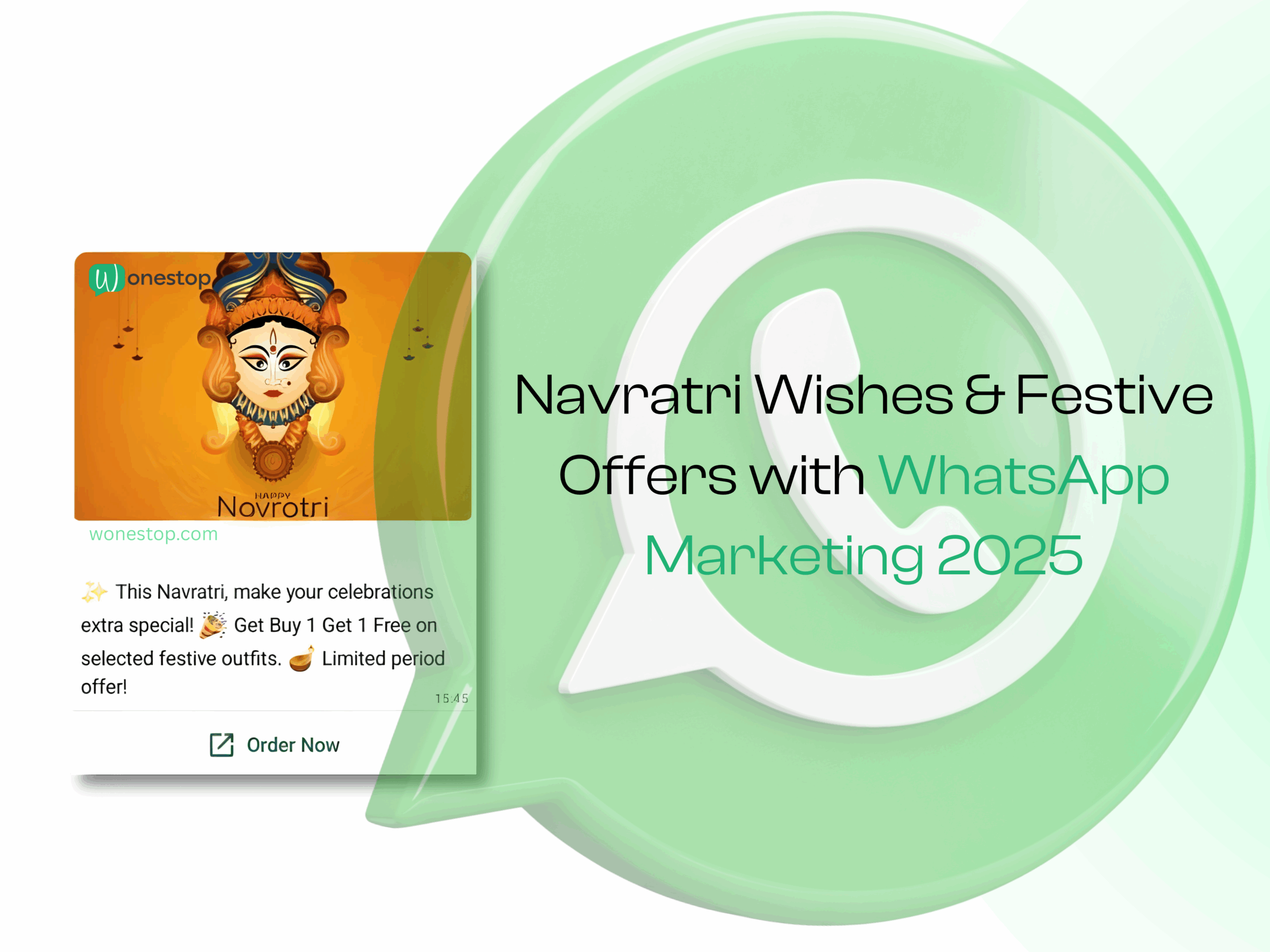
  • Navratri Wishes and Festive Offers with WhatsApp Marketing 2025

    Navratri Wishes and Festive Offers with WhatsApp Marketing 2025

    Navratri 2025 is here, and with it comes nine days of devotion, joy, and celebration. While people are busy with Garba nights, family gatherings, and shopping, businesses are also preparing for one of the biggest festive seasons of the year.

    From fashion stores to restaurants, every business wants to connect with customers during Navratri. And in today’s world, the best way to reach them is through WhatsApp.

    WhatsApp isn’t just for sending personal Navratri wishes anymore. It has become a powerful tool for businesses to share festive offers, discounts, and greetings directly with customers. In this blog, let’s explore how different industries can send Navratri wishes & WhatsApp offers in 2025 — and how tools like Wonestop make it simple with broadcasts and templates.

    Why Businesses Should Use WhatsApp During Navratri

    • Instant connection – Customers check WhatsApp more than email or SMS.
    • Personal touch—Messages feel like one-to-one wishes, not just ads.
    • Easy to share – Customers can forward offers to family and friends.

    Navratri WhatsApp Messages for Different Businesses

    Each business can send a slightly different style of message, depending on its audience. Let’s see some examples. 👇

    1. Fashion & Clothing Stores

    Customers love buying new outfits for Garba nights and festive gatherings.

    Message Example:
    “🌸 Happy Navratri 2025! Get ready to shine in style. Flat 25% OFF on festive kurtis and lehengas. Offer valid till Navami. Shop now 👉 [link]”

    2. Jewelry Shops

    Navratri and Dussehra are auspicious times for buying jewelry.

    Message Example:
    “✨ Celebrate Navratri with sparkle! Wishing you joy and blessings. Get the Festive Gold Collection at 10% OFF this week. Visit us 👉 [link]”

    3. Restaurants & Food Businesses

    Families love ordering food or sweets during the celebrations.

    Message Example:
    “🍴 Happy Navratri! Enjoy our Fasting Special Menu delivered to your doorstep. Order today & get 15% OFF + Free Dessert. Tap to order 👉 [link]”

    4. Electronics & Home Appliances

    Festive season = shopping for big items.

    Message Example:
    “💡 Celebrate Navratri with new beginnings! Get Up to 30% OFF on LED TVs & Appliances. Special festive EMI options are available. Shop now 👉 [link]”

    5. Salons & Beauty Services

    People want to look their best for Garba nights.

    Message Example:
    “💃 Get festive-ready this Navratri! Book your Makeup & Hair Package at 20% OFF. Limited slots available. Book now 👉 [link]”

    6. Travel & Tour Agencies

    Navratri holidays are a time for short trips.

    Message Example:
    “✈️ Happy Navratri! Plan a festive getaway with your family. Navratri Travel Deals starting at ₹4,999. Book your trip now 👉 [link]”

    How Businesses Can Send These Messages Easily

    Now, you might be thinking, “How do I send these messages to all my customers without typing each one?”

    That’s where the Wonestop WhatsApp Marketing Tool helps.

    With Wonestop, businesses can:

     ✅ Create template messages—Design festive greetings with offers, images, and links.
    Broadcast to large contacts – Send one message to thousands of customers at once.
    Automate festive flows – For example, if someone replies “Yes,” they automatically get your product catalog or menu.
    Schedule messages—Plan wishes and offers in advance (like sending Day 1, Day 5, and Day 9 messages).
    Track responses—See how many people opened, clicked, or responded.

    Example of How Wonestop Can Help

    Imagine you own a fashion boutique.

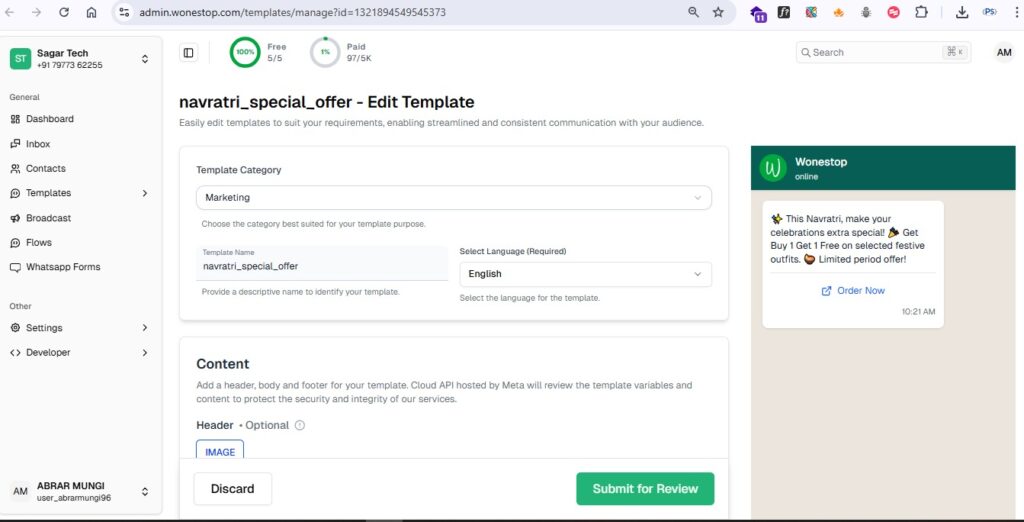
    1. You create a Navratri wish and offer template inside Wonestop:
      “🌼 Happy Navratri! Shop our latest festive kurtis with 20% OFF. Tap here 👉 [link].”
      whatsapp template
    2. Upload your customer contact list.
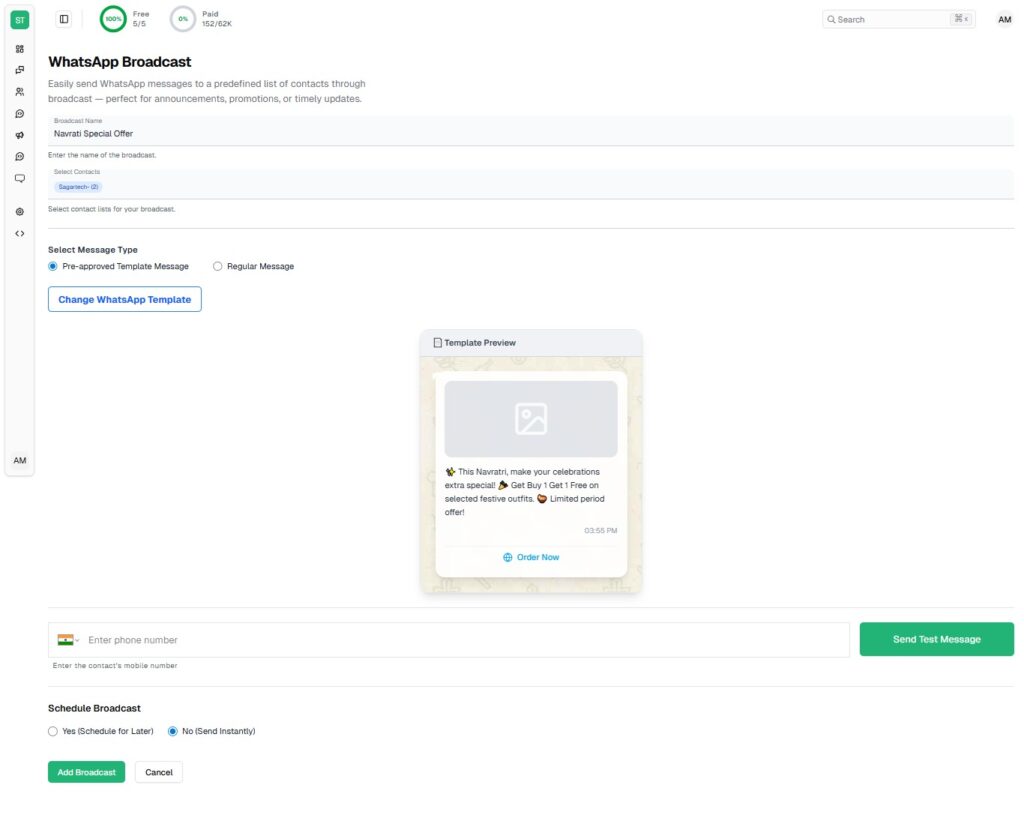
    3. Use the broadcast feature to send it to 1,000+ customers instantly.
      whatsapp broadcast
    4. Add an automatic flow—if someone replies “Yes,” they get your product catalog on WhatsApp.

    Result? You save time, reach more customers, and boost your Navratri sales.

    Final Thoughts

    Navratri is more than just a festival—it’s a celebration of new beginnings. For businesses, it’s also the perfect time to connect with customers in a warm yet professional way.

    By sending Navratri wishes & festive offers on WhatsApp in 2025, you can spread positivity and boost sales. And with the power of Wonestop, you don’t have to do it manually — you can automate your broadcasts, design festive templates, and engage customers at scale.

    ✨ This Navratri 2025, let Wonestop help you send the right wishes, the right offers, to the right people—at the right time.

    ✨ This Navratri 2025, let Wonestop help you send the right wishes, the right offers, to the right people—at the right time.

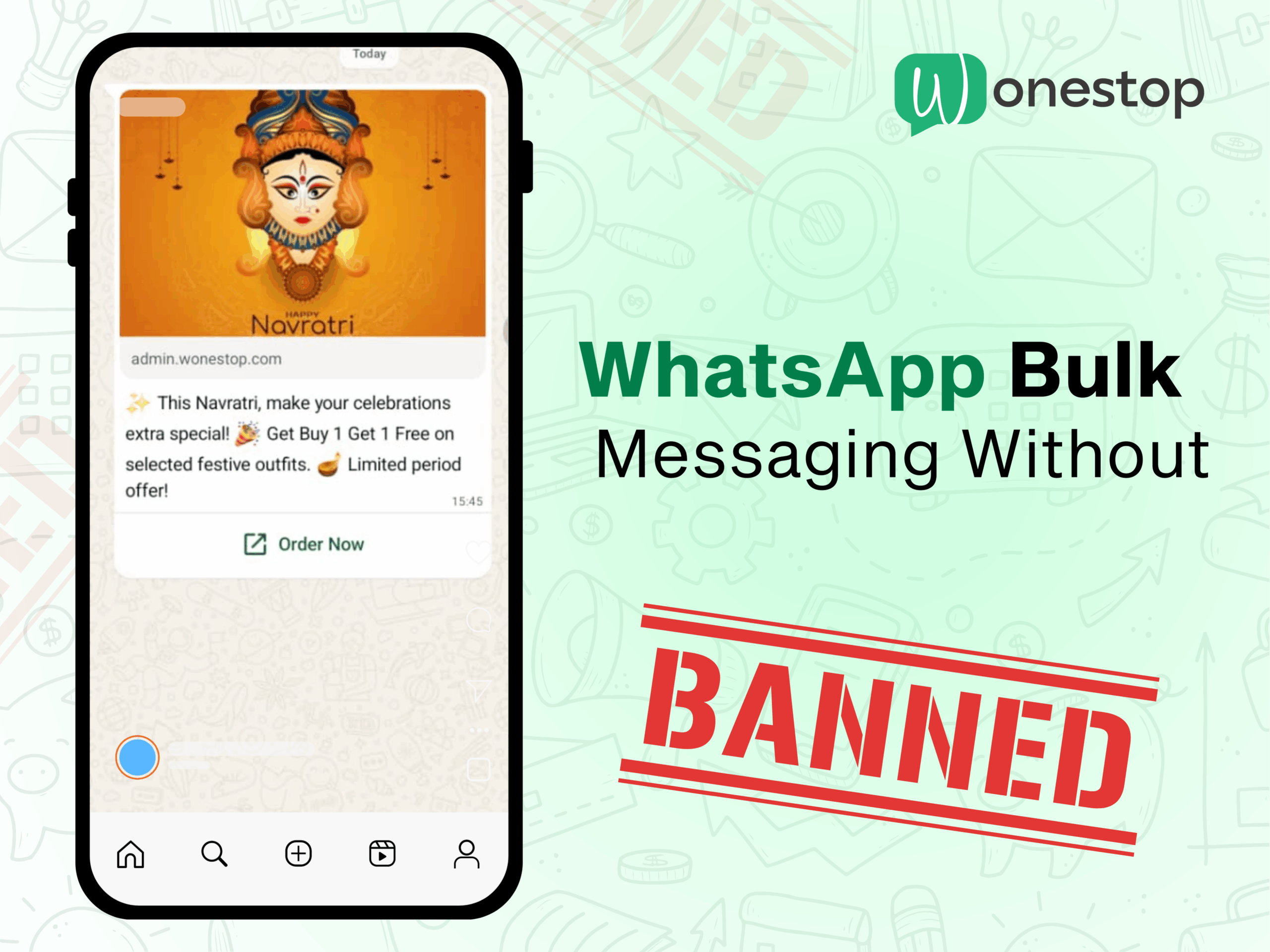
  • How to Do WhatsApp Bulk Messaging Without Ban

    How to Do WhatsApp Bulk Messaging Without Ban

    WhatsApp is becoming more than just a personal messaging software; it’s one of the best ways for companies to interact with their clientele. WhatsApp offers immediate reach and high engagement for providing information, promotions, or reminders; only 20–25% of emails and 30–40% of SMS are opened, compared to 98% of messages.

    The problem is that sending WhatsApp bulk messaging in the wrong way can result in your number being blocked. This is why it’s so important to know how to do it correctly. We’ll go over how companies can send bulk WhatsApp messages securely, stay out of trouble, and improve their client base in this blog.

    Why Businesses Choose WhatsApp Bulk Messaging

    WhatsApp is the ideal tool for communicating with customers because people check it several times a day.  WhatsApp texting in mass is used by businesses because it provides:

    • High visibility—most WhatsApp messages are read within minutes.
    • Direct connection—instant, two-way conversations with customers.
    • Cost-effective marketing—cheaper and more impactful than traditional advertising.
    • Rich content options – Share not just text but also images, videos, PDFs, and catalogs.

    In countries like India, where WhatsApp is widely used, companies rely heavily on a bulk WhatsApp messaging service in India to reach audiences quickly and effectively.

    Why Do WhatsApp Accounts Get Banned?

    WhatsApp works hard to protect users from spam. You risk having your account flagged or banned if your bulk messaging looks suspicious. Some common reasons include:

    • Sending thousands of people the same messages all at once.
    • Adding people to groups without their permission.
    • Sharing promotional content without user consent.
    • Sending a large number of WhatsApp messages using fake or banned apps.

    The good news is that you can send mass messages without fear of being banned if you follow the proper procedures.

    Safe Ways to Do WhatsApp Bulk Messaging Without Ban

    1. Use an Official Platform like Wonestop

    Unofficial apps may promise bulk messaging, but they risk bans. Instead, use trusted solutions like Wonestop, which is built on the official WhatsApp Business API. It helps businesses send thousands of messages while staying 100% compliant with WhatsApp rules.
    2. Always Take User Consent

    Verify that clients agreed to receive your communications. This could be through a sign-up form, a website pop-up, or an in-store request. Consent reduces spam complaints and builds trust.

    3. Personalize Messages

    Avoid robotic, copy-paste messages. Instead of sending the same text to everyone, personalize your bulk WhatsApp message with names or tailored offers. Example:

    Generic: “Big sale today. Don’t miss out!”
    Personalized: “Hi Ankit, our weekend sale is live! Grab your special discount today.”

    This small change makes a big difference.

    4. Don’t Overdo It

    Flooding customers with too many messages in a day can feel spammy. Send bulk messages only when you have valuable information, promotions, or updates.

    5. Build a Verified Business Profile

    A verified profile adds credibility and improves customer trust. Platforms like Wonestop help businesses maintain a professional and verified presence on WhatsApp.

    6. Share Useful Content

    Mix promotions with value. For example, along with offers, send order updates, payment confirmations, appointment reminders, or festival greetings. Customers are more likely to engage when your messages are relevant.

    Why Choose a Bulk WhatsApp Messaging Service in India

    Managing hundreds or thousands of customers manually is time-consuming. That’s where a bulk WhatsApp messaging service in India comes in handy. With platforms like Wonestop, you get:

    • Automation—Schedule campaigns for the right time.
    • Analytics—Track open rates, clicks, and customer replies.
    • Segmentation – Target specific groups with tailored messages.
    • Secure delivery—Stay compliant with WhatsApp policies.

    This guarantees that the right people always hear what you’re saying, saves time, and boosts productivity.

    Read More: Wonestop: One-Stop Solution for WhatsApp Marketing

    WhatsApp Bulk SMS vs Bulk WhatsApp Messaging

    Many people confuse WhatsApp bulk SMS with bulk WhatsApp messaging, but they are different:

    WhatsApp Bulk SMS – Usually refers to sending SMS text messages via WhatsApp numbers.

    Bulk WhatsApp Messaging—Uses WhatsApp directly to send texts, videos, images, and rich media.

    For modern businesses, bulk WhatsApp messaging is far more powerful and engaging than SMS.

    Final Thoughts

    WhatsApp bulk messaging is a game-changer for businesses that want to connect with their customers instantly. But to avoid bans, you need to do it the right way: get user consent, personalize messages, avoid spamming, and most importantly, use a trusted platform like Wonestop.

    By choosing a reliable bulk WhatsApp messaging service in India, you can scale your communication, deliver value, and grow customer trust—all while staying compliant with WhatsApp rules.

    Think carefully the next time you’re planning a marketing strategy. Select bulk WhatsApp messaging that is simple to use, quick, and safe—and protect your number from restrictions.